Juki MO-1000 Review: Is Jet-Air Threading Worth the Price?
An honest Juki MO-1000 serger review: how jet-air threading works, stitch quality, noise, the rolled hem, how it compares with the Brother Airflow 3000 and Juki MO-654DE, and who should save their money.
· 5 min read
As an Amazon Associate we earn from qualifying purchases. Details

Ask a room of sewists what they dislike about sergers and most will give the same answer: threading the loopers. The Juki MO-1000 was built to make that answer disappear. You push the thread into a hole, press a lever, and a puff of air carries it through the looper in a second.
It is also one of the most expensive home sergers you can buy. So is it worth it? For some people, absolutely. For others, the money is better spent elsewhere. Here is how to tell which one you are.
The short version
How jet-air threading works
On a hand-threaded serger, the upper and lower loopers are threaded through a maze of guides, and the lower looper in particular is tucked away where fingers struggle to reach. On the MO-1000 you thread the upper part of each looper path as normal, then push the thread end a short way into a threading port. Press the air lever, and the thread shoots through a tube and out of the looper eye.
The two needles use a built-in needle threader, so there is no squinting at either. The whole machine can be threaded from scratch in a few minutes, and after the first week it feels routine. Our serger threading guide explains the general order, which still applies.
What we like
It changes how often you change thread
With a hand-threaded serger, many people tie new thread onto the old and pull it through rather than re-thread. That trick doesn’t work with air threading, but you don’t need it: re-threading is so quick that changing to a matching color for every project stops being a chore.
The stitch quality
The MO-1000 sews a very even, flat overlock on jersey, cotton and linen, and the differential feed handles both stretchy and slippery fabric well. It is noticeably quieter and smoother than budget sergers, with less vibration at speed.
Tension that stays put
Once the tensions are balanced, they stay balanced from one fabric to the next more than on lighter machines. If you are new to serger tension, our serger tension guide and its free printable cheat sheet will help you read your stitch.
The rolled hem
The rolled hem is built in and lovely on napkins, scarves and chiffon. Switching to it is a matter of a lever and a tension change, with no plate to swap.
What could be better
The price
There’s no way around it: the MO-1000 usually costs over $1,000. That is money that could buy a Brother 1034DX and a good sewing machine together. If you can thread a serger by hand without trouble, you will be just as happy with a cheaper machine.
It is heavier
It sits solidly on the table, which is good for stitching, but it isn’t one to carry to classes every week.
You must keep the air path clean
Lint in the threading tubes can stop air threading working. A quick brush and a puff of air after each project prevents this; our how to clean a serger routine covers it.
Juki MO-1000 specifications
| Feature | Juki MO-1000 |
|---|---|
| Threads | 2, 3 or 4 |
| Looper threading | Jet-air, both loopers |
| Needle threading | Built-in needle threader |
| Top speed | 1,500 stitches per minute |
| Differential feed | Yes |
| Rolled hem | Built in |
| Price tier | Over $800 |
Juki MO-1000 vs Brother Airflow 3000
The Brother Airflow 3000 also air-threads its loopers and usually costs several hundred dollars less. It is a very good choice if you want air threading on a smaller budget, and Brother’s friendly controls and clear manual help. The Juki feels more solid, runs more smoothly at speed and has a longer track record with owners. If budget allows, the Juki; if not, the Airflow 3000 still solves the threading problem. Both are compared in our best serger guide.
Juki MO-1000 vs Juki MO-654DE
The MO-654DE is the Juki many sewists buy for heavy fabrics. It is just as sturdy and costs much less, but you thread it by hand. If your hands manage hand threading, the MO-654DE is the better value. If they don’t, the MO-1000 is worth every extra dollar.
Who should buy something else
- If you are not sure you will serge often, start with the Brother 1034DX, our best serger for beginners.
- If you want T-shirt style hems, a serger can’t sew them. You need a coverstitch machine; read our Brother 2340CV review.
- If you mostly sew heavy fabrics on a budget, the Juki MO-654DE is the sturdy choice.
Accessories worth getting
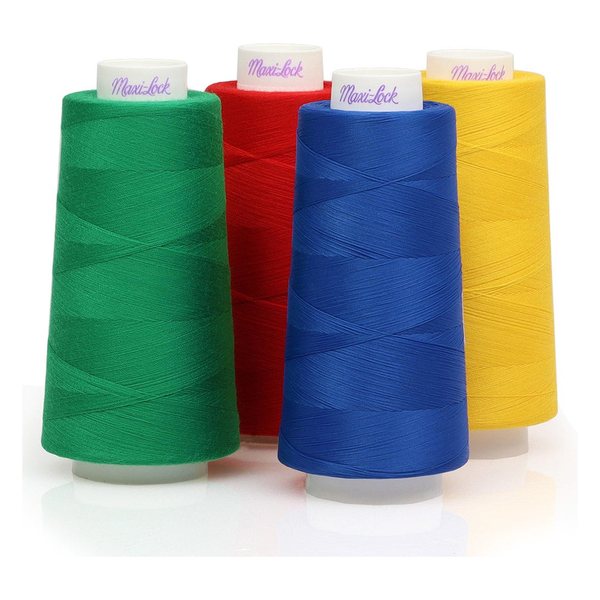
- Good serger thread on cones. Maxi-Lock cones run smoothly through air ports; avoid fuzzy bargain thread. See our best serger thread picks.
- Woolly nylon for rolled hems and swimwear: Maxi-Lock Stretch.
- Spare needles and a lint brush. Change needles every few projects.
Juki MO-1000 questions
Is the Juki MO-1000 worth the money?
It is if threading a serger by hand is difficult or frustrating for you, or if you serge often and change thread colors a lot. If hand threading doesn’t bother you, a cheaper serger will sew just as well for most projects.
Can you use any thread with jet-air threading?
Standard serger cone thread works well. Very fuzzy or heavy decorative threads can struggle through the air tubes, and some textured threads are best threaded by hand. Check your manual for the recommended threads.
Does the Juki MO-1000 do a coverstitch?
No. It is an overlock serger with 2, 3 and 4 thread stitches and a rolled hem. For a coverstitch you need a separate machine or a combination serger.
Is the Juki MO-1000 good for beginners?
Yes, if the budget allows. It is one of the easiest sergers to learn on because threading, the part beginners find hardest, takes seconds.
The verdict
The Juki MO-1000 is the serger we recommend to anyone who has struggled with threading, and it’s a pleasure to sew on as well. It is expensive, so be honest about how often you will use it. If you serge every week, or threading has kept you away from a serger entirely, it is worth saving for. See it alongside every other serger we’ve rated in our sewing machine and serger reviews.
See the Juki MO-1000 on Amazon