How to convert embroidery thread colors
- Choose the brand you have. That might be the thread a pattern calls for, or the spool in your hand.
- Type the color number. Leading zeros don’t matter, so 15 finds Isacord 0015. You can also type a color name like “navy”.
- Pick the brands to compare. Tick the brands you own or can buy. You will see the nearest shade in each, plus two close runners-up.
- Read the match. Near-identical and Very close matches are safe swaps. Close is fine for small details. Nearest available means that brand simply has nothing similar.
- Need the whole range? Open Full chart to see every color in a brand matched across all the others, then print it or download it for your sewing room.
Isacord to Madeira, Sulky, Brother and DMC conversion chart
Here are 36 Isacord colors chosen to cover the whole spectrum, from whites and blacks through every hue, with the closest match in four machine thread lines and DMC floss. For every one of the 398 Isacord shades, or a chart for any other brand, use the Full chart tab above.
| Isacord | Madeira Classic Rayon | Madeira Polyneon | Sulky Rayon 40 | Brother Embroidery | DMC Six-Strand Floss |
|---|---|---|---|---|---|
| 1950 Tropical Pink | 1109 Ruby Glint | 1709 Passion | 1192 Fuchsia | 620 Magenta | 3607 Plum Light |
| 2530 Rose | 1108 Dusty Rose | 1921 Wild Pink | 1515 Rosebud | 085 Pink | 3806 Cyclamen Pink Light |
| 2211 Pomegranate | 1389 Brushed Burgundy | 1785 Grape Shake | 1309 Magenta | 869 Royal Purple | 915 Plum Dark |
| 2155 Pink Tulip | 1115 Crystal Pink | 1713 Petal Pink | 1225 Pastel Pink | 124 Flesh Pink | 761 Salmon Light |
| 1526 Apple Butter | 1174 Burgundy | 1899 Red Bittersweet | 1214 Med. Chestnut | 333 Amber Red | 3777 Terra Cotta Very Dark |
| 1800 Wildfire | 1378 Sunkist | 1987 Fluorescent Orange | 1039 True Red | 800 Red | 606 Orange?Red Bright |
| 1600 Spanish Tile | 1152 Arctic Ice | 1820 Flamingo | 1259 Salmon Peach | 030 Vermilion | 3778 Terra Cotta Light |
| 1304 Red Pepper | 1065 Mango | 1955 Honeydew | 1238 Orange Sunrise | 209 Tangerine | 971 Pumpkin |
| 0933 Redwood | 1056 Wicker | 1973 Chocolate | 1170 Lt. Brown | 323 Light Brown | 420 Hazelnut Brown Dark |
| 1565 Espresso | 1229 Dark Grey | 1744 Egyptian Brown | 1179 Dk. Taupe | 704 Pewter | 839 Beige Brown Dark |
| 5866 Herb Green | 1194 Desert Cactus | 1757 Dark Green / Yellow | 1058 Tawny Brown | 058 Dark Brown | 801 Coffee Brown Dark |
| 0940 Autumn Leaf | 1359 Pollen Gold | 1772 Old Gold | 1159 Temple Gold | 348 Khaki | 3852 Straw Very Dark |
| 0873 Stone | 1305 Light Green / Yellow | 1738 Pistachio | 1321 Gray Khaki | 399 Warm Gray | 3023 Brown Gray Light |
| 0608 Sunshine | 1223 Canary | 1824 Canary | 1187 Mimosa Yellow | 206 Harvest Gold | 444 Lemon Dark |
| 6043 Yellowgreen | 1140 Tamarack | 1769 Pale Green | 1276 Pistachio | 330 Russet Brown | 730 Olive Green Very Dark |
| 0250 Lemon Frost | 1022 Medium Yellow | 1661 Celery | 1061 Pale Yellow | 010 Cream Brown | 3078 Golden Yellow Very Light |
| 5940 Sour Apple Neon | 1150 Pebblestone | 1935 Lemon | 1067 Lemon Yellow | 027 Fresh Green | 907 Parrot Green Light |
| 5500 Limedrop | 1248 Sharp Green | 1850 Green | 1278 Bright Green | 509 Leaf Green | 703 Chartreuse |
| 5374 Forest Green | 1370 Evergreen | 1902 Mitchell Green | 1208 Mallard Green | 808 Deep Green | 890 Pistachio Green Ultra Very Dark |
| 5450 Basic Seafoam | 1097 Bleached Aqua | 1900 Nile | 1045 Lt. Teal | 542 Seacrest | 955 Nile Green Light |
| 5411 Shamrock | 1079 Kelly | 1651 Kelly | 1046 Teal | 515 Moss Green | 910 Emerald Green Dark |
| 5005 Rain Forest | 1284 Green Forest | 1985 Green | 1090 Deep Peacock | 507 Emerald Green | 3818 Emerald Green Ultra Very Dark |
| 4230 Aqua | 1045 Seafrost | 1892 Turquoise | 1145 Powder Blue | 017 Light Blue | 964 Sea Green Light |
| 4010 Caribbean Blue | 1093 Indian Ocean Blue | 1892 Turquoise | 1094 Med. Turquoise | 017 Light Blue | 3845 Turquoise Bright Medium |
| 4033 Tartan Blue | 1296 Peacock | 1776 Blue | 1250 Duck Wing Blue | 415 Peacock Blue | 311 Wedgewood Ultra Very Dark |
| 3815 Reef Blue | 1029 Dolphin Blue | 1828 Pale Purple | 1534 Sapphire | 019 Sky Blue | 322 Baby Blue Dark |
| 3641 Wedgewood | 1261 Pastel Lilac | 1629 Paris Blue | 1028 Baby Blue | 804 Lavender | 156 Blue Violet Medium Light |
| 2864 Columbine | 1362 Light Midnight | 1617 Gray Ridge | 1283 Slate Gray | 704 Pewter | 158 Cornflower Blue Medium Very Dark |
| 3611 Blue Ribbon | 1360 Country Blue | 1960 Country Blue | 1561 Deep Hyacinth | 607 Wistaria Violet | 931 Antique Blue Medium |
| 3353 Light Midnight | 1366 Violet Blue | 1722 Purple Maze | 572 Blue Ribbon | 007 Prussian Blue | 823 Navy Blue Dark |
| 3510 Electric Blue | 1376 Salem Blue | 1962 Dark Blue | 1226 Dk. Periwinkle | 614 Purple | 3750 Antique Blue Very Dark |
| 3110 Dark Ink | 1033 Mulberry | 1880 Dark Purple | 1235 Deep Purple | 613 Violet | 3837 Lavender Ultra Dark |
| 2640 Frosted Plum | 1031 Carnatio | 1911 Light Pink | 1296 Hyacinth | 810 Light Lilac | 210 Lavender Medium |
| 0015 White | 1003 Natural White | 1804 Blanc De Blanc | 1002 Soft White | 001 White | B5200 Snow White |
| 0111 Whale | 1288 Moon Mist | 1740 Silver Rose | 1295 Sterling | 817 Gray | 169 Pewter Light |
| 0020 Black | 1006 Diamond Black | 1800 Black | 1005 Black | 900 Black | 310 Black |
Why thread colors never match exactly between brands
Every thread company mixes its own dyes, names its own colors and numbers them its own way. Isacord’s 1902 Poinsettia and Madeira’s nearest red are cousins, not twins. A conversion chart finds the closest relative, and for most projects that is all you need.
Rayon and polyester shine differently
Rayon reflects light with a soft, silky glow, while polyester tends to look a touch brighter and crisper. The same color can read slightly lighter or darker depending on the fiber and the direction of the stitches. Satin stitches catch more light than fill stitches, so a column of satin often looks paler than the spool.
Screens and dye lots
The colors here are the approximate screen values thread makers and the open-source embroidery community publish. Your phone and your laptop will show them a little differently, and one dye lot can vary slightly from the next. Treat the converter as a way to narrow the choice to one or two spools, then make the final call with the real thread on your fabric.
Embroidery thread brands at a glance
| Brand | Fiber and weight | Known for |
|---|---|---|
| Isacord | Polyester, 40 wt | Strong, colorfast, bleach-safe. A favorite for towels, kids’ clothes and anything washed often. |
| Madeira Classic Rayon | Rayon, 40 wt | The classic high-sheen look. Beautiful on heirloom pieces and linens that are washed gently. |
| Madeira Polyneon | Polyester, 40 wt | Madeira’s polyester line with a near-rayon shine. Good all-rounder. |
| Brother Embroidery | Polyester, 40 wt | Matches the color numbers built into Brother and Baby Lock machines and PES files. |
| Sulky Rayon 40 | Rayon, 40 wt | Soft, glossy and easy to find in craft stores. Huge color range. |
| Robison-Anton | Polyester or rayon, 40 wt | A workhorse of commercial embroidery shops, sold in big cones. |
| Floriani | Polyester, 40 wt | Bright, even color and very low lint. Popular with quilters who embroider. |
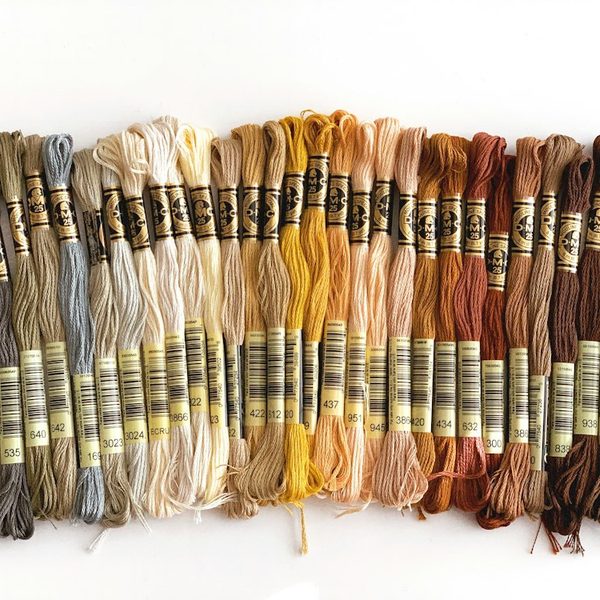
| DMC Six-Strand Floss | Cotton floss | For hand embroidery and cross stitch, not for machines. Over 450 shades. |
If you are just starting out, a boxed set of 40 or 63 polyester colors from Brother, Isacord or Simthread covers almost every design you will download. Our guide to the best thread for your sewing machine explains thread weights and which bobbin thread to pair with them, and the best thread for quilting covers thread for quilts and quilt labels.
Converting DMC floss to machine embroidery thread
DMC six-strand cotton is the standard for hand embroidery and cross stitch, so it is the brand most patterns and kits are written for. If you want a machine-stitched piece to sit alongside hand work, or you are turning a cross stitch chart into a machine design, choose DMC as the brand you have and tick the machine threads you own. The converter will show you which spool comes closest.
It works the other way, too. Pick your machine thread, and the DMC column tells you which floss to buy for hand-stitched details, French knots or a matching quilt label. Our guide to hand sewing stitches has the basics if you are new to stitching by hand.
Tips for substituting a thread color
Match the lightness first
Your eye notices a change in how light or dark a color is far more than a small shift in hue. If you must choose between two matches, pick the one with the right depth. A slightly warmer red that is just as dark will look right; a perfect hue that is two shades lighter will not.
Think about neighbors
A color looks different depending on what sits next to it. When you swap one thread in a design, hold the new spool against the other colors you are using, not on its own.
Stitch a test
Run the design, or just the part with the new color, on a scrap of the same fabric with the same stabilizer. Five minutes of testing saves a ruined towel or shirt.
Keep a real color card
If you buy one brand often, its printed color card or a card wound with real thread is worth having. Use the converter to shortlist, then check the card.
How Brother and Janome machines name thread colors
PES files from Brother and Baby Lock, and JEF files from Janome, do not store a real color. They store a number from the machine maker’s built-in thread chart. That is why your machine might call a color “Deep Rose” even though you plan to stitch it in Isacord. When our monogram and name file maker saves a PES or JEF file, it picks the nearest color from that chart for you. To see which chart color a thread you own lines up with, choose Brother or Janome in the Compare with list above.
You will find more free helpers on the embroidery tools page, and plenty of sewing and quilting guides on the Beauty of Sewing home page.
Thread colors come from the open thread palettes published by the Ink/Stitch project (GPL-3.0) and a widely shared DMC floss RGB table. Brand names belong to their owners; we are not affiliated with any thread company.
Questions people ask
Is there an exact match for every thread between brands?
Rarely. Each company dyes its own colors, so a conversion gives you the closest shade, not a twin. When the converter says Near-identical, most people will not see a difference once it is stitched. Very close is fine for most projects. For a large fill area or matching a logo, compare real thread side by side before you commit.
What is the DMC equivalent of a Madeira or Isacord color?
Choose Madeira or Isacord in the converter, type the thread number, and you will see the nearest DMC floss along with the other brands. DMC floss is cotton for hand embroidery, so it matches the color, not the shine. Rayon and polyester machine thread will always look glossier.
Can I use DMC floss in my embroidery machine?
Not as it comes. Six-strand floss is too thick and loosely twisted for a machine needle. If you want a design to match a hand-stitched piece, use the converter to find the closest machine thread instead.
How accurate are the colors on screen?
They are a good guide, not a guarantee. Thread colors are published as approximate screen values, every monitor shows color a little differently, and dye lots vary. Use the matches to narrow your choice to one or two spools, then check them in daylight against your fabric.
Does it matter if I swap rayon for polyester?
For color, no. For the finished piece, a little. Rayon has a softer, silkier sheen and is lovely on heirloom work. Polyester is stronger and stands up to bleach and hot washes, so it is the better pick for towels, baby things and work wear. Both are usually 40 weight, so a design stitches the same with either.
Why does my machine show a different color name than my spool?
Brother, Baby Lock and Janome files do not store a real color. They store a number from the machine maker’s own thread chart, and the machine shows that name. Pick Brother or Janome in the converter to find which of their chart colors is closest to the thread you plan to use.