Which skirt pattern suits you?
| Style | Best for | Level | Time |
|---|
| Gathered rectangle | A first garment, everyday comfort | Beginner | 2 to 3 hours |
| Elastic-waist A-line | A smoother tummy, linen and cotton | Beginner | About 3 hours |
| Circle | Twirl, parties, petticoats | Confident beginner | About 3 hours |
| Half circle | Flattering midi and maxi lengths | Confident beginner | 2 to 3 hours |
| Wrap with ties | Adjustable fit, travel | Confident beginner | About 3 hours |
| Tiered maxi | Summer, boho, long lengths | Beginner | An afternoon |
| Knit pencil | A neat office or church skirt | Confident beginner | About 1½ hours |
How to measure for a skirt
Measure over the underwear you will wear with the skirt, with the tape level and snug but not tight. It helps to tie a piece of narrow elastic around your middle first. It settles at your natural waist, so you measure from the same place every time.
Waist
Measure around your natural waist, the narrowest part of your middle, usually just above the belly button. If you like your skirts to sit lower, measure where you want the waistband to sit instead.
Hips
Measure around the fullest part of your hips and seat, usually 7 to 9 inches below the waist. For every pull-on skirt, this is the measurement that matters, because the waist has to stretch over it.
Length
Measure down your side from the waist to where you want the hem. Take a favorite skirt from the wardrobe and measure it too. It is the most reliable guide to a length you already like.
Choosing fabric for skirts
Drape matters more than print. Scrunch a corner of the fabric in your hand in the shop: if it falls in soft folds, it will gather nicely; if it holds a crisp shape, save it for a circle or A-line skirt.
- Rayon challis and viscose: beautiful drape for gathered, tiered and wrap skirts. Pre-wash, as it can shrink.
- Cotton lawn and voile: light, cool and easy to sew. Perfect for tiered maxis.
- Linen and linen blends: lovely for A-line and half circle skirts. It softens with every wash.
- Quilting cotton: fine for a casual gathered skirt or a child's skirt, but stiffer than apparel fabric.
- Ponte knit: the right choice for the pull-on pencil skirt.
For drapey fabric, swap pins for clips and use a fresh needle. Our guide to choosing sewing thread explains which thread to pair with each fabric. Looking for a Christmas tree skirt? That is a different project. Our free Christmas tree skirt pattern has you covered.
Skirt sewing skills worth learning
Every skirt on this page uses the same handful of skills. Brush up on a straight seam, practise a zipper before you sew one into a circle skirt, and learn a neat hand-stitched hem for the finest finish. New to the machine? Start with how to use a sewing machine and the stitches it can sew. Want something easier first? See our easy sewing projects for beginners.
Skirt sewing questions
What is the easiest skirt to sew for a beginner?
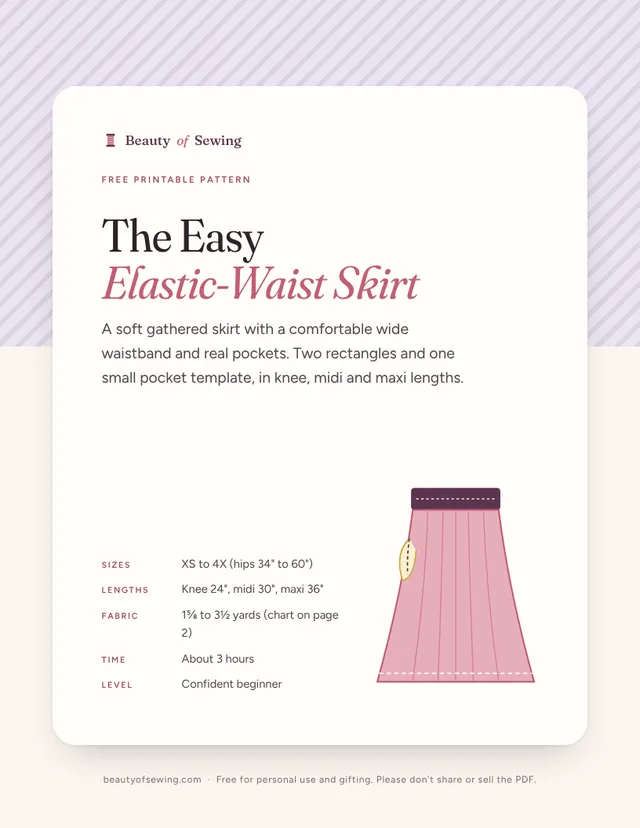
A gathered rectangle skirt with an elastic waist. It is two rectangles, two side seams, a casing and a hem, so there are no curves, darts or zippers. Our free elastic-waist skirt pattern is exactly that, with pockets added and a size chart from XS to 4X.
How do I calculate a circle skirt?
Divide your waist measurement by 2π (6.28) for a full circle, by π (3.14) for a half circle, or by π and multiply by 2 for a quarter circle. That gives the waist radius. Add the skirt length and hem allowance to get the outer radius. Subtract your seam allowance from the waist radius before cutting. The calculator on this page does all of it and tells you how much fabric to buy.
How much fabric do I need for a circle skirt?
For a knee-length full circle skirt on a 30 inch waist you need about 1¾ yards of 60 inch fabric, cut in one piece, or about 3⅜ yards of 44 inch fabric, cut in two halves with side seams. Longer skirts and narrower fabric need much more, which is why a half circle is often the better choice for midi and maxi lengths.
Can I make a circle skirt with an elastic waist?
Yes. Use your hip measurement plus 2 inches instead of your waist in the calculator, so the opening slides over your hips, then add an elastic casing or a wide elastic waistband. Choose the elastic setting in the calculator and it does this for you.
What is the best fabric for a skirt?
For gathered and tiered skirts, choose soft fabrics that drape: rayon challis, cotton lawn, double gauze, linen or a light chambray. Circle skirts look best in fabrics with body, like cotton sateen, linen blends or a medium-weight crepe. Pencil skirts need a knit with good stretch and recovery, such as ponte.
Why does my circle skirt hem look uneven?
Parts of a circle skirt are cut on the bias, and bias stretches as it hangs. Hang the finished skirt for 24 hours before you hem it, then level the hem with a helper or a dress form and trim it before stitching. A narrow rolled hem or a serged edge also helps it fall evenly.
How long should a skirt be?
Measure from your waist down your side to where you want the hem. As a guide, a knee-length skirt is around 22 to 24 inches, a midi 28 to 32 inches and a maxi 36 to 40 inches, but your own measurement is always better than a chart.